Complete Guide to Monitoring & Observability
Implement comprehensive monitoring and observability solutions for maximum system visibility, performance optimization, and proactive incident management
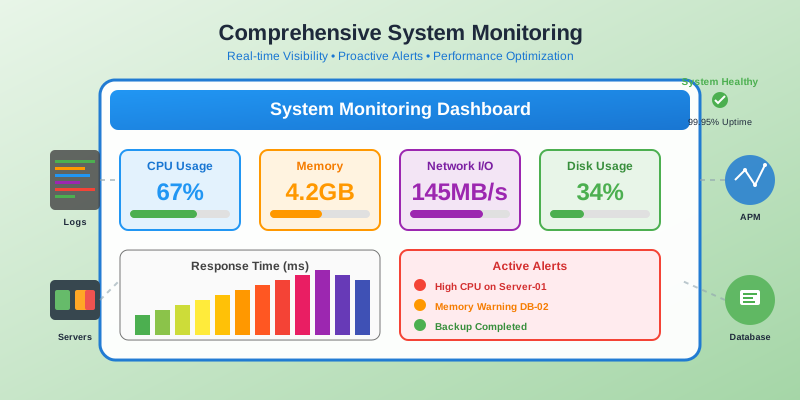
Modern distributed systems are inherently complex. Microservices architectures, containerized workloads, and multi-cloud deployments create environments where traditional monitoring approaches fall short. You can't manage what you can't see—and seeing clearly into these systems requires a comprehensive observability strategy.
Observability goes beyond monitoring. While monitoring tells you when something is wrong, observability helps you understand why. It provides the data and tools to explore system behavior, trace request flows across services, and correlate events across your entire infrastructure. This guide covers both foundational monitoring and advanced observability practices.
Why Comprehensive Monitoring Matters
Organizations with mature observability practices resolve incidents faster, catch issues before customers notice, and make data-driven capacity decisions. The benefits compound over time as teams build intuition about system behavior and create effective alerting strategies.
99.95%
System Visibility
Complete infrastructure oversight
90%
Faster Response
Reduced incident resolution time
75%
Less Downtime
Proactive issue prevention
24/7
Monitoring
Continuous system oversight
Complete Monitoring Stack
Infrastructure Monitoring
Comprehensive monitoring of servers, networks, databases, and cloud resources with real-time metrics and alerting.
- Server and network monitoring
- Database performance tracking
- Cloud resource optimization
- Capacity planning and forecasting
- Custom metric collection
Application Performance Monitoring
Deep application insights with distributed tracing, error tracking, and performance optimization recommendations.
- Distributed tracing and spans
- Error tracking and debugging
- Performance bottleneck analysis
- User experience monitoring
- Code-level visibility
Log Management & Analytics
Centralized log aggregation, analysis, and correlation for comprehensive system troubleshooting and security monitoring.
- Centralized log aggregation
- Real-time log analysis
- Security event correlation
- Custom log parsing and filtering
- Long-term log retention
Alerting & Incident Response
Intelligent alerting with automated incident response, escalation workflows, and integration with popular tools.
- Smart alerting and noise reduction
- Automated incident response
- Escalation and on-call management
- Integration with Slack, PagerDuty, Jira
- Post-incident analysis and reporting
The Three Pillars of Observability
Modern observability is built on three complementary data types: metrics, logs, and traces. Each provides a different lens for understanding system behavior, and together they enable comprehensive visibility into even the most complex environments.
Metrics
Numerical measurements collected at regular intervals. Metrics are efficient to store and query, making them ideal for dashboards, alerting, and trend analysis. Examples include CPU utilization, request latency percentiles, and error rates.
Tools: Prometheus, Grafana, CloudWatch Metrics, Datadog
Logs
Timestamped records of discrete events. Logs provide detailed context about what happened at a specific moment—errors, state changes, user actions. They're essential for debugging but can be expensive at scale.
Tools: Loki, Elasticsearch, CloudWatch Logs, Splunk
Traces
Records of request flows across distributed systems. Traces show the path a request takes through your services, revealing latency contributors, error sources, and dependency relationships.
Tools: Jaeger, Zipkin, AWS X-Ray, Honeycomb
Building Effective Alerting Strategies
Alert fatigue is one of the biggest challenges in monitoring. When teams receive too many alerts—especially false positives or low-priority notifications—they start ignoring them. This defeats the purpose of monitoring and can lead to missed critical issues.
Symptoms vs. Causes
Alert on symptoms that affect users—high error rates, slow response times, service unavailability—rather than causes like high CPU. Users don't care if your CPU is at 90% as long as the service works. Cause-based alerts generate noise without actionable context.
SLO-Based Alerting
Define Service Level Objectives (SLOs) that capture what "good" looks like, then alert when you're burning through your error budget too quickly. This approach reduces alert volume while ensuring you catch issues that matter to users.
Severity Levels
Not all alerts need immediate human response. Define clear severity levels: critical alerts page on-call immediately, warnings create tickets for business-hours follow-up, and informational alerts go to dashboards for awareness.
Runbook Links
Every alert should link to a runbook explaining what the alert means, how to investigate, and steps to remediate. This enables anyone on-call to handle incidents, not just the engineer who created the alert.
OpenTelemetry: The Future of Observability
OpenTelemetry (OTel) is rapidly becoming the standard for observability instrumentation. This vendor-neutral framework provides APIs, SDKs, and tools for generating and collecting telemetry data—metrics, logs, and traces—from your applications and infrastructure.
The key benefits of OpenTelemetry include vendor independence (instrument once, export to any backend), consistent instrumentation across languages and frameworks, rich automatic instrumentation for common libraries, and active community support from major vendors and cloud providers.
OpenTelemetry Architecture
- APIs: Language-specific interfaces for creating telemetry
- SDKs: Implementations that process and export telemetry
- Collector: Vendor-agnostic service for receiving, processing, and exporting data
- Exporters: Send data to backends like Prometheus, Jaeger, or commercial tools
Implementing Observability: A Practical Roadmap
Phase 1: Foundation
- Deploy infrastructure monitoring for servers, containers, and cloud resources
- Implement centralized logging with structured log formats
- Create basic dashboards for key services and infrastructure
- Set up on-call rotation and incident response process
Phase 2: Application Observability
- Add application-level metrics (request rate, error rate, latency)
- Implement distributed tracing for critical user journeys
- Define SLOs and error budgets for key services
- Create service-level dashboards with business context
Phase 3: Advanced Capabilities
- Implement SLO-based alerting with error budget burn rate
- Deploy anomaly detection for proactive issue identification
- Automate runbooks for common remediation scenarios
- Integrate observability data with incident management tools
Frequently Asked Questions
The three pillars are: Metrics (numerical measurements like CPU usage and request latency), Logs (timestamped records of discrete events), and Traces (records of request flows across distributed systems). Each provides a different lens into system behavior. Metrics are efficient for dashboards and alerting. Logs provide detailed context for debugging. Traces reveal how requests flow through microservices.
We reduce alert fatigue through several strategies: alerting on symptoms (user-facing issues like errors and latency) rather than causes (CPU utilization), implementing SLO-based alerting that focuses on error budget burn rate, defining clear severity levels so not all alerts page on-call, and ensuring every alert links to a runbook with clear remediation steps. The goal is fewer, more actionable alerts.
OpenTelemetry (OTel) is a vendor-neutral framework for generating and collecting telemetry data—metrics, logs, and traces. It's becoming the industry standard for observability instrumentation. You should use it because it provides vendor independence (instrument once, export to any backend), consistent instrumentation across languages, and rich automatic instrumentation for common libraries. It's the future-proof choice for observability.
We recommend a phased approach over 3-6 months. Phase 1 (weeks 1-4) establishes foundation with infrastructure monitoring, centralized logging, and basic dashboards. Phase 2 (weeks 5-8) adds application-level metrics, distributed tracing, and SLOs. Phase 3 (weeks 9-12+) implements advanced capabilities like SLO-based alerting, anomaly detection, and automated remediation. The timeline varies based on environment complexity.

HostingX Solutions LLC
FinOps, DevOps, and automation for US and European SaaS teams.
Services

Subscribe to our newsletter
Get monthly email updates about improvements.
© 2026 HostingX Solutions LLC. All Rights Reserved.
LLC No. 0008072296 | Est. 2026 | New Mexico, USA
Terms of Service
Privacy Policy
Acceptable Use Policy